How We Work
We do the homework first. Then we ask once.
Most of what you need to know is already in your numbers. So we start from your data, build our own understanding of it, and only then come to you with one list of specific questions. Your team keeps doing its job. After one scoping call, we don’t set up workshops or interview sessions with your staff.
Four steps
1. One scoping call. A short call, usually 30 minutes, with whoever owns the engagement: which accounts, which period, who the result is for, and the deadline. Afterwards we send a short written brief to confirm what we agreed.
2. We work on our own. You give us the data (see below) and we go through it: reconcile, break down, age, and look for what doesn’t fit. Where the numbers don’t explain something, we write down our assumption instead of stopping to ask.
3. We ask one list of questions. Not a trickle of messages. One list, each question specific and answerable in a line, with our assumption next to it. You confirm it, correct it, or point us to a document.
4. We finalise and hand over. Schedules, management notes, proposed adjustments, and the assumption log, updated with your answers.
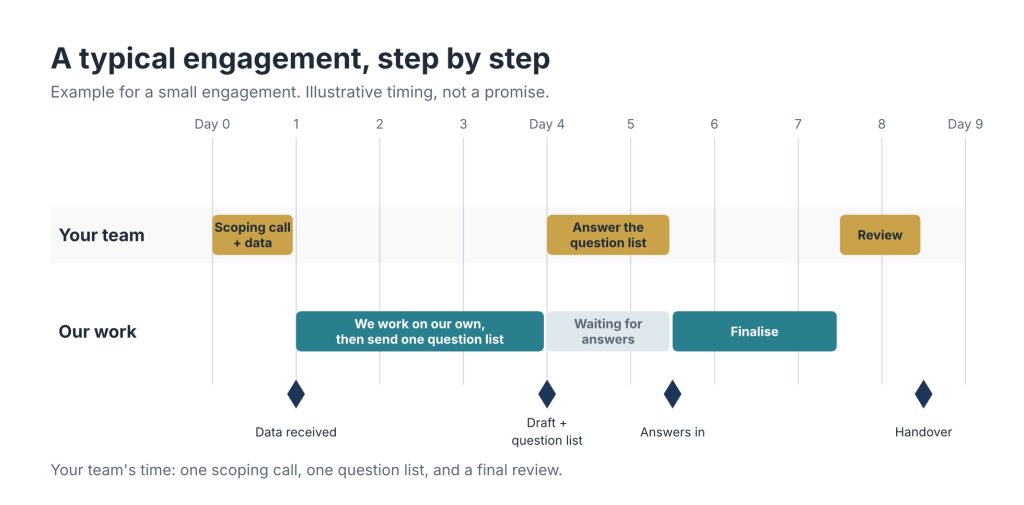
Your team’s total time on a typical engagement: a weekly meeting or any that is set up during the scoping stage.
How we get your data
You choose what your policy allows:
| Option | What it means | Good for |
|---|---|---|
| Exports | Your team sends ledger and subledger exports as Excel or CSV files | Most engagements. No system access needed |
| Shared folder | A Google Drive or similar folder where you drop files and we read them | When there are many supporting documents |
| View-only access | A read-only login to your system, if your policy and IT team allow it | Larger or recurring work, where exports would be repeated |
We never need the ability to post, change, or delete anything in your system.
We sign an NDA before receiving any data; files are kept in a restricted folder; at the end we can return or delete them.
What you receive
- The reconciliation and detail workbook, one tab per account
- A short plain-language note per account for management
- Proposed adjustments, each with its reason and evidence
- The assumption log: what we assumed, what you confirmed, what you corrected
- Anything else that is set during scoping stage
How you’ll know where we are
You get a short update at each milestone, not a report every day. We keep a simple shared status sheet, so you can see which step we are on and what is waiting on whom. If something is blocked, we say so the same day.
What we need from you
- The data, in one of the forms above
- One person we can send the question list to
- Answers to that list within, so the timeline holds
What’s included
- Scope: the accounts and period agreed in the brief
- Revisions, if needed.
- Done means: all questions answered or marked open, and the schedules and notes delivered and accepted by you
- Anything outside that scope, such as extra accounts or another period, we quote separately before starting
Ready to start?
Send us a short brief through the [Contact page]. We’ll reply with what we need and a timeline.
Leave a Reply