Balance Sheet Reconciliation and Account Analysis
Every balance on your balance sheet should have a story you can tell in two minutes. Most of them don’t.
Open the trial balance and you’ll find lines like “Other receivables: IDR 4.2 billion”. The finance team knows roughly what is in it. The CFO or the board doesn’t, and the auditor wants support in a form they can test. So someone spends three days rebuilding the same schedule from the ledger, again, at year-end.
We do that work, and we leave you with something you can keep using.
What we do
1. Reconcile the account. We tie the ledger balance to something outside the ledger: a subledger, a bank or vendor statement, a contract, a register. Differences are listed and explained, not netted away.
2. Break it down. A detail listing by counterparty, by age, and by nature, so “other receivables” (or any account) becomes a list a person can actually read. Anything old, unusual, or without support is flagged.
3. Explain it in plain language. One page per account for management: what the balance is, why it is this size, what changed since last period, and what needs a decision. No jargon that needs a second meeting to translate.
4. Support the audit. A schedule your auditor can use, with the supporting documents indexed against each line, ready before they ask for it.
5. Propose adjustments. Where something is misclassified or doesn’t belong, we propose the correcting entry together with the reason. Your team reviews and posts.
6. Make it routine. For accounts that need attention every month, we set up the template, the owner, and the aging rule, so the reconciliation stops being a year-end project.
Accounts we work on
| Account | The question we hear | What you get |
|---|---|---|
| Other receivables | What is in this, and who owes it? | Listing by counterparty and age, with a status on each line |
| Prepayments and advances | Is this still valid, or should it be expensed? | Schedule showing the period covered and an amortisation check |
| Accrued expenses | Is this complete, and is it real? Is it not double with the AP? | Listing tied to POs, contracts, and invoices that arrived later |
| Accounts payable | Does our balance match the vendor’s? | Vendor statement reconciliation |
| Intercompany | Why don’t the two sides agree? | Reconciliation by counterparty with the differences explained |
| Fixed assets | Does the register match the ledger? | Register-to-ledger reconciliation with additions and disposals |
| Clearing and suspense accounts | Why is there a balance at all? | Aging and proposed clearing entries |
| GR/IR | What do we do about this balance? | A specialised review. See our [GR/IR page] |
From a one-liner to an explanation
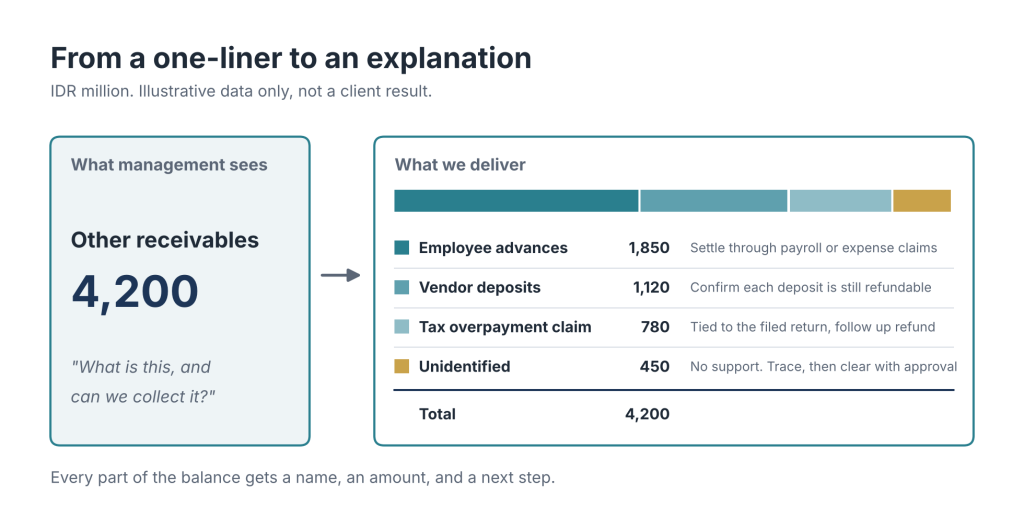
This is the kind of page management ends up with. The numbers in the example are made up, and the structure is what matters: every part of the balance has a name, an amount, and a next step.
How it works
- We talk for 30 minutes. You tell us which accounts, which period, and who needs to understand the result: management, the auditor, or both.
- Your team sends the trial balance and the ledger detail for those accounts as exports. Any system that can export to Excel will do.
- We reconcile and break down each account, then send a draft with the open questions listed.
- We go through it with your team, close the questions, and finalise the schedules and the management notes.
What we won’t do
We’re not your auditor and we don’t give audit opinions. We support your team and your auditor, we don’t replace them. We won’t write off a balance because it is old, and we don’t post anything in your system. Every proposed adjustment comes with its evidence.
Who you’ll work with
CMD Accounting Advisory Solution is led by a finance professional with more than 20 years of experience, up to VP Finance Controller, across oil and gas, insurance, and travel. The founder holds a CMA and an MM degree.
More about us: About
Talk to us
If this sounds like your situation, send a message through the [Contact page]. A short note is enough: which accounts, which period, and what the result is for.
Leave a Reply